
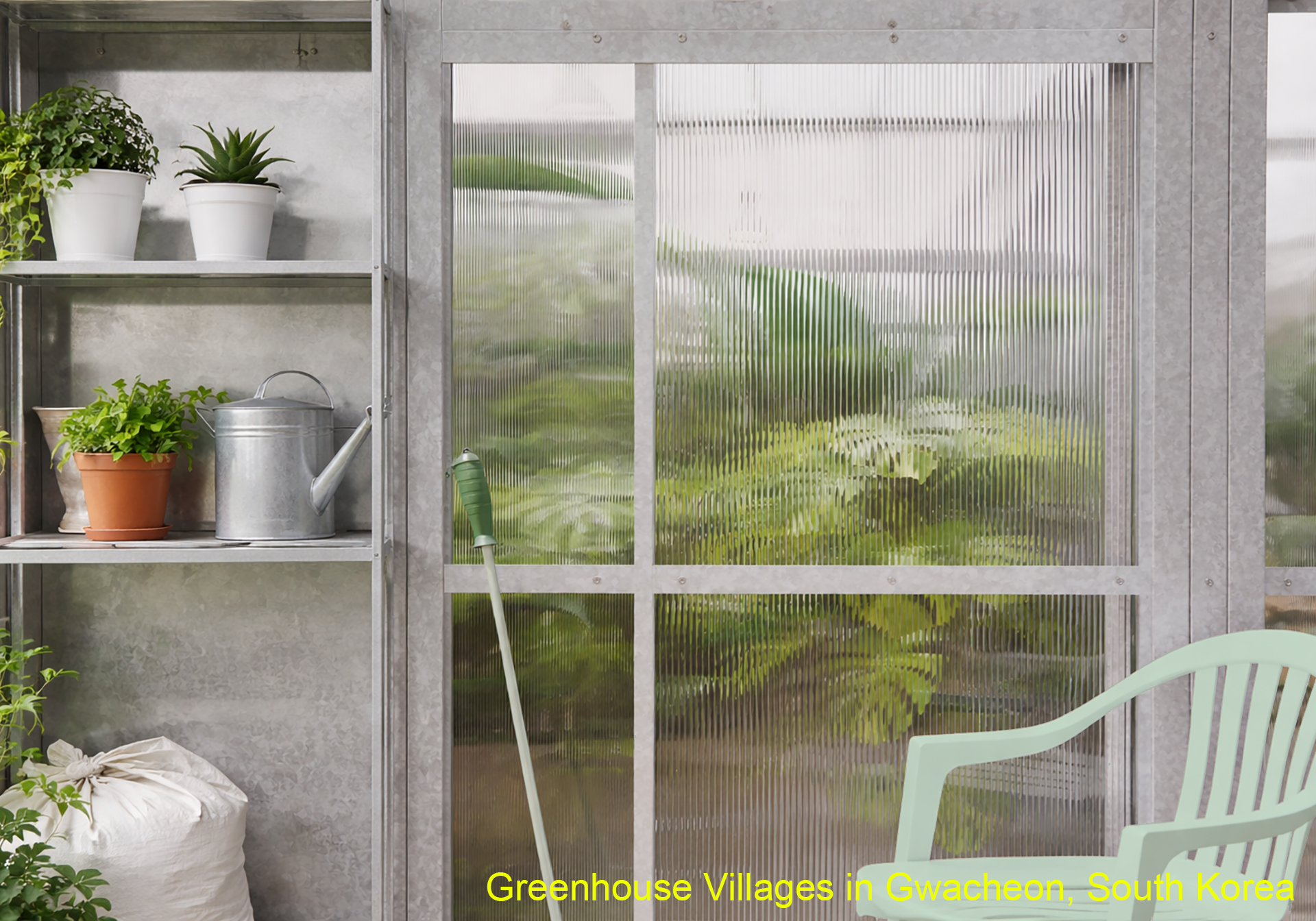

Green House Villages in Gwacheon, South Korea
South Korea
2025
Research by Eunsoo Jang
In Gwacheon, South Korea—where about 80% of the land is designated as Green Belt—around 450 low-income households live in informal “greenhouse villages.” These settlements, formed in the 1980s by people displaced during urban redevelopment, consist of agricultural greenhouses illegally converted into housing. Though used as homes, they remain officially registered as agricultural facilities, forcing residents to circumvent legal restrictions just to survive.
These structures lack insulation, electricity, sewage, and running water, creating harsh and unstable living conditions. While public housing developments threaten further displacement, the proposed public housing units are often unaffordable or too small for the affected residents.
This project proposes a hybrid housing model within existing legal boundaries. Greenhouses are reused as living spaces, while essential utilities—bathroom, kitchen, water, and electricity—are installed in a legally permitted 20m² farm hut. A portion of each site remains in agricultural use to comply with Green Belt regulations.
The layout follows existing village paths and organizes homes around shared courtyards that foster both community life and small-scale farming.
This model presents a practical and lawful alternative for low-income greenhouse residents, reimagining the Green Belt as a space not of exclusion, but of inclusion and possibility.