

Gendered land rights in Hong Kong’s feudal villages
Hong Kong
2025
Research by Sheren Lai
No Woman’s Land interrogates the gendered spatial and legal structures embedded within Hong Kong’s Small House Policy by reimagining village land as a collective, rather than patrilineal, resource. The policy’s foundational unit—the Ding Uk—institutionalizes male-only inheritance and construction rights within New Territories’ indigenous villages, producing a spatial regime in which women are structurally excluded from land ownership and housing provision. Despite its intent to preserve rural traditions, the policy has become increasingly incompatible with contemporary conditions of land scarcity, speculative development, and demographic change.
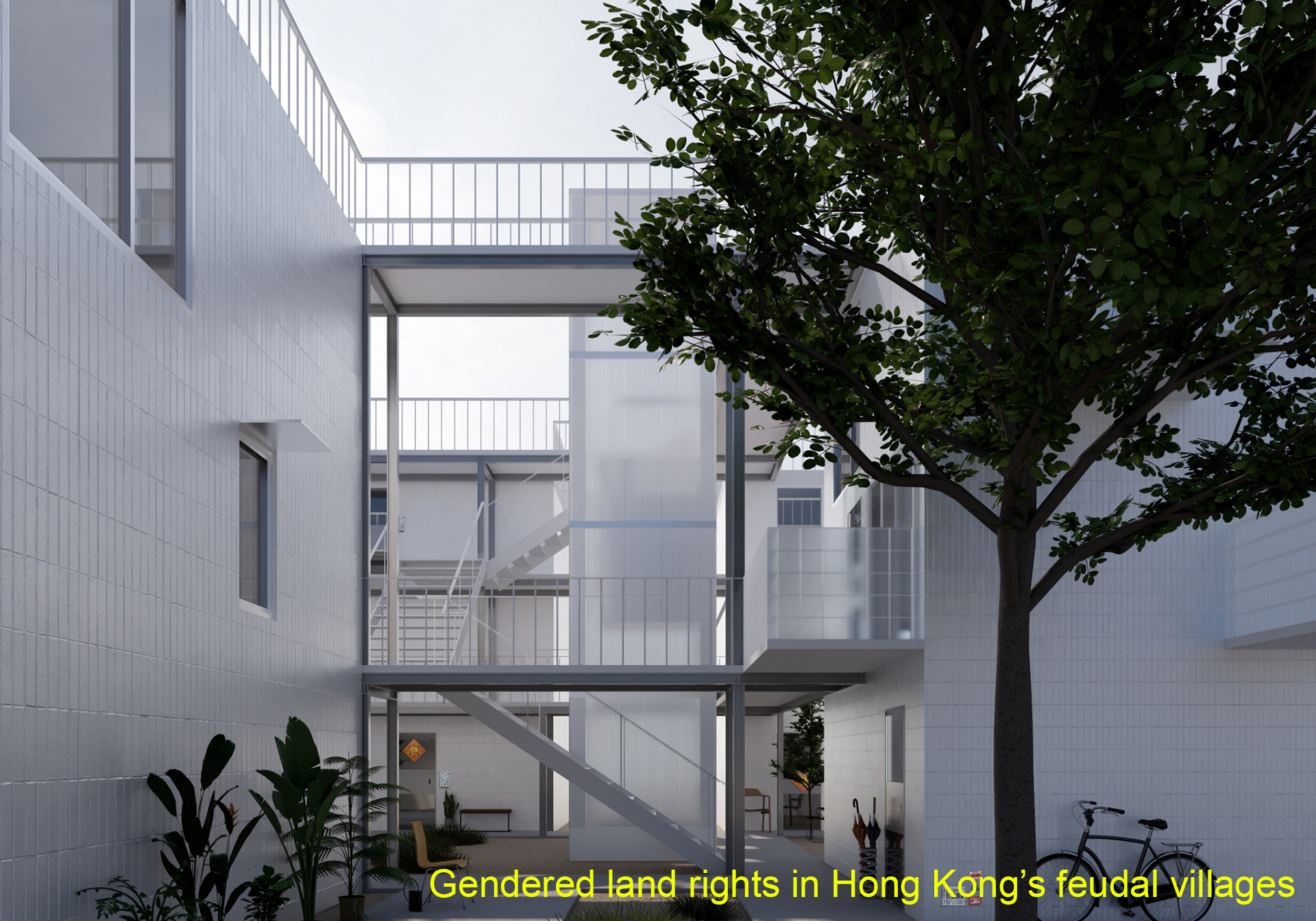
Situated on a Tang family–owned carpark in Ping Shan, the project proposes a speculative housing prototype that repurposes unused Ding rights through a cooperative governance model. Rather than monetizing these rights through informal transactions with private developers, the ancestral trust (Tso) is reconceived as a housing association that aggregates dormant entitlements and redistributes them as affordable rental housing for all villagers, irrespective of gender, marital status, or lineage. Rental income functions as the primary financial mechanism, enabling long-term sustainability without reliance on speculative land valorization.
The architectural strategy adopts a phased construction approach to ensure the continuity of existing carpark revenue while incrementally densifying the site. Each phase introduces compact clusters of ten residential units organized around shared courtyards, elevated circulation, and accessible rooftop spaces, fostering communal interaction across generations. Drawing inspiration from “Less Serious Unauthorized Building Works,” the design embraces informal construction logics, modular adaptability, and porous spatial configurations as a critique of rigid planning norms.
Cultural practices such as Poon Choi feasts and temporary bamboo theatre structures are spatially integrated to reinforce collective memory and social continuity. By reframing indigenous land as a shared civic asset, No Woman’s Land articulates an alternative model of rural urbanism that challenges patriarchal land governance while proposing a replicable framework for inclusive village redevelopment in post-industrial urban contexts.